

How Much Federal Money Has Baltimore Are Received In 2018
 | |
| Submitted | March 16, 2017 |
|---|---|
| Submitted by | Donald Trump |
| Submitted to | 115th Congress |
| Total revenue | $3.654 trillion (estimated) $three.330 trillion (actual) [1] xvi.v% of GDP[2] |
| Total expenditures | $4.094 trillion[3] (requested) $four.109 trillion (actual) [1] twenty.3% of Gdp[2] |
| Deficit | $440 billion (requested) $779 billion (actual) [one] 3.viii% of Gdp[2] |
| GDP | $20.236 trillion[one] |
| Website | Official website containing the 2018 budget |
| ‹ 2017 2019 › | |
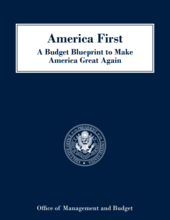
The Usa federal budget for fiscal year 2018, which ran from October 1, 2017, to September xxx, 2018, was named America Beginning: A Budget Blueprint to Make America Great Again. It was the kickoff budget proposed by newly elected president Donald Trump, submitted to the 115th Congress on March 16, 2017.[4] [5]
The government was initially funded through a series of five temporary continuing resolutions. The concluding funding parcel was passed equally an motorbus spending bill, the Consolidated Appropriations Human action, 2018, enacted on March 23, 2018.
Background [edit]
Donald Trump was elected as President of the United states in the November viii, 2016 ballot, candidature for the Republican Party on a platform of tax cuts and projects like the Mexican border wall. During his campaign, Trump promised to cut federal spending and taxes for individuals and corporations.
Trump administration budget proposal [edit]
| | This article needs to be updated. (September 2019) |

The Trump administration proposed its 2018 budget on February 27, 2017, ahead of his address to Congress, outlining $54 billion in cuts to federal agencies and an increase in defense force spending.[6] On March 16, 2017, President Trump sent his budget proposal to Congress, remaining largely unchanged from the initial proposal.[vii] The OMB estimated FY2018 would involve outlays of $4.094 trillion and revenues of $3.654 trillion, a $440 billion deficit. The 2018–2027 period planned $48.901T in outlays and $45.751T in revenues, a $three.15T deficit.[8]
CBO scoring of the budget [edit]

CBO chart explaining the impact of the 2018 budget on spending, revenue enhancement revenue, and deficits over the 2018–2027 periods
The Congressional Budget Part reported its evaluation of the budget on July 13, 2017, including its furnishings over the 2018–2027 catamenia.
- Mandatory spending: The budget cuts mandatory spending by a net $two.033 trillion (T) over the 2018–2027 menstruum. This includes reduced spending of $1.891T for healthcare, mainly due to the proposed repeal and replacement of the Affordable Care Human action (ACA/Obamacare); $238 billion (B) in income security ("welfare"); and $100 billion in reduced subsidies for student loans. These savings would exist partially offset by $200B in additional infrastructure investment.
- Discretionary spending: The budget cuts discretionary spending by a cyberspace $1.851 trillion over the 2018–2027 menses. This includes reduced spending of $752 billion for overseas contingency operations (defense spending in Afghanistan and other foreign countries), which is partially outset past other increases in defense spending of $448B, for a net defence force cut of $304B. Other discretionary spending (cabinet departments) would be reduced by $one.548T.
- Revenues would exist reduced by $1 trillion, mainly by repealing the ACA, which had applied higher tax rates to the top v% of income earners. Trump'southward budget proposal was not sufficiently specific to score other tax proposals; these were merely described as "deficit neutral" by the Administration.
- Deficits: CBO estimated that based on the policies in place as of the start of the Trump administration, the debt increase over the 2018–2027 period would be $ten.112T. If all of President Trump's proposals were implemented, CBO estimated that the sum of the deficits (debt increases) for the 2018–2027 period would be reduced by $3.276T, resulting in $6.836T in total debt added over the menstruum.[9]
- CBO estimated that the debt held by the public, the major subset of the national debt, would ascension from $14.168T (77.0% Gross domestic product) in 2016 to $22.337T (79.eight% GDP) in 2027 under the President's budget.[10]
Department and programme changes [edit]
The proposed 2018 budget includes $54 billion in cuts to federal departments, and a corresponding increase in defense and military spending.[11] [12]
| Department | Budget | Corporeality change | Pct alter | Notes |
|---|---|---|---|---|
| Department of Agriculture | $17.nine billion | $−4.7 billion | −21% | Includes the emptying of food for education and water and wastewater loan programs. Decreases funding for the United States Forest Service by $118 1000000.[thirteen] |
| Department of Commerce | $seven.8 billion | $−ane.4 billion | −16% | Includes cuts to coastal research programs at the National Oceanic and Atmospheric Administration, and the elimination of the Economic Evolution Administration |
| Department of Defence | $574 billion | $52 billion | +nine% | Includes an increase in the size of the Army and Marine Corps, equally well as the Naval armada |
| Department of Education | $68.ii billion | $−9.2 billion | −xiv% | Cuts programs and grants for teacher grooming, afterward-schoolhouse and summer care, and aid to low-income students. Eliminates $1.ii billion from the 21st Century Customs Learning Eye program and cuts $732 million from the Federal Supplemental Educational Opportunity Grant. Eliminates Striving Readers/Comprehensive Literacy Development Grants as well every bit cuts funding for Supporting Constructive Education Country grants by $2.three billion.[xiv] |
| Department of Energy | $28 billion | $−1.7 billion | −6% | Largest cuts go to the Part of Science; ARPA-Due east and Departmental Loan Programs eliminated. Increases spending on National Nuclear Security Administration by eleven.4% while slashing high free energy physics and almost all other science programs (Basic Free energy Sciences, Biological and Environmental Research, Fusion Energy Sciences, High Free energy Physics, Nuclear Physics, Infrastructure and Administration, Workforce Development for Teachers and Scientists) by 18%. The only science program not to receive a cut is the Advanced Scientific Calculating Research program, which is to receive a small budget increase of $101 million. Coin spent on the NNSA would go to the modernization and upkeep of nuclear weapons as well as $1.5 billion going to naval nuclear reactors. The budget cuts funding for energy programs by over fifty% reducing the funding by $2.4 billion. Energy programs cutting include: Energy Efficiency and Renewable Energy, Electricity Delivery and Energy Reliability, Nuclear Energy, Fossil Energy Research and Development.[15] [16] |
| Department of Health and Human Services | $65.1 billion | $−fifteen.one billion | −eighteen% | Cuts funding for the National Institutes of Health and training programs. Proposes phasing out many functions of the US Public Health Service. |
| Department of Homeland Security | $44.1 billion | $2.8 billion | +vii% | Increases spending on border security and immigration enforcement and builds a wall on the The states-United mexican states edge. Cuts funding for certain FEMA grant programs. |
| Department of Housing and Urban Development | $40.7 billion | $−6.two billion | −thirteen% | Eliminates grant programs for community development, investment partnerships, domicile-ownership, and Section 4 affordable housing |
| Department of the Interior | $11.seven billion | $−1.half-dozen billion | −12% | Eliminates over 4000 jobs. Eliminates funding for 49 National Historic Sites and decreases funding for land acquisition. Decreases funding for Cooperative Endangered Species Conservation Fund. Cuts funding by $2 million for dealing with invasive species.[17] [18] |
| Department of Justice | $27.7 billion | $−one.ane billion | −4% | Reduces spending on prison construction and reimbursements to land and local governments for incarceration of undocumented immigrants |
| Department of Labor | $9.6 billion | $−2.6 billion | −21% | Eliminates funding for senior-work programs, grants for not-profits and public agencies used for health preparation, and closes some Task Corps centers |
| State Department | $27.1 billion | $−10.ix billion | −29% | Eliminates funding for United Nations programs, including peacekeeping and climate change mitigation |
| Department of Transportation | $16.2 billion | $−2.4 billion | −13% | Eliminates funding for the Federal Transit Administration's New Starts grant program, long-altitude Amtrak service, cuts the TIGER grant programme and eliminates funding for the Essential Air Service. Air traffic control would be shifted to private service under the proposal. |
| Treasury Department | $11.2 billion | $−0.5 billion | −iv% | Reduces funding for the Internal Revenue Service |
| Department of Veterans Affairs | $78.9 billion | $4.four billion | +6% | Expands health services and the benefit claims system. Individual Unemployability (IU) for veterans eligible for Social Security retirement benefits would be terminated upon reaching the minimum retirement age for Social Security purposes, or upon enactment of the proposal if the Veteran is already in receipt of Social Security retirement benefits. These Veterans would continue to receive VA disability benefits based on their original disability rating, at the scheduler evaluation level. IU benefits would not be terminated for Veterans who are ineligible for Social Security retirement benefits, thus allowing them to go on to receive IU past minimum retirement age. Savings to the Bounty and Pensions business relationship are estimated to be $3.two billion in 2018, $17.ix billion over five years, and $40.viii billion over x years.[19] |
| Ecology Protection Agency | $5.7 billion | $−2.5 billion | −31% | Eliminates more than 50 programs and iii,200 jobs |
| National Aeronautics and Space Assistants (NASA) | $19.1 billion | $-0.1 billion | −1% | Cuts funding for World scientific discipline programs and missions, and eliminates the Office of Education. Cuts funding for the Aeronautics Enquiry Mission Directorate past $166 one thousand thousand (−21%). Cuts funding for Space Engineering science research by $148.4 million (−eighteen%). Cuts funding for Human being Exploration Operations by $478.nine 1000000 (−53%). Cuts funding for the Instruction programme past $62.seven meg (−62.7%).[xx] [21] |
| Small Business Administration | $.eight billion | $−0.1 billion | −v% | Eliminates technical-assist grant programs |
The $971 meg upkeep for arts and cultural agencies, including the Corporation for Public Broadcasting, National Endowment for the Arts, and National Endowment for the Humanities, would be eliminated entirely.
Criticism [edit]
A recipient of the Nobel Memorial Prize in Economic Sciences, economist Joseph Stiglitz said near the 2018 budget proposal: "Trump's budget takes a sledgehammer to what remains of the American Dream".[22] Senator Bernie Sanders also criticized the proposal: "This is a budget which says that if you are a member of the Trump family, you lot may receive a tax pause of upwardly to $4 billion, but if you are a child of a working-grade family, you could well lose the wellness insurance you currently take through the Children'south Wellness Insurance Program and massive cuts to Medicaid".[23] The actual text of the budget blueprint did not seem to include any cuts to CHIP or Medicaid at the time; however, the ultimate Senate pecker stipulates that extension of CHIP funding will not increment the deficit, while not mentioning Medicaid, which did not require extension for FY2018.[24]
Congressional budget resolution [edit]
On Oct 17, 2017, the Senate started to debate the 2018 proposed budget.[25] On October xix, 2017, Senator Heidi Heitkamp (D-North.D.) proposed an amendment to preclude tax increases on people making less than $250,000 a year. It would have also required the Senate to approve a tax-reform bill with 60 votes rather than a simple bulk. Senate Budget Commission Chairman Mike Enzi (R-Wyo.) chosen this language a "poison pill," and the amendment was defeated 51-47.[26] Several Republican amendments were adopted with broad support. Senator Jeff Flake (R-Ariz.) proposed language to make the "American revenue enhancement system simpler and fairer for all Americans," which passed 98-0. Senator Marco Rubio (R-Fla.) proposed an amendment in back up of increasing the child tax credit, which passed by voice vote, pregnant it was approved without any Senator raising an issue.[26] Senator John McCain (R-Ariz.), chairman of the Senate Armed services Committee, offered an subpoena to ensure increases in federal defense spending are prioritized over increases in spending in other areas. "Defense and nondefense are not of the aforementioned urgency," he told reporters Thursday. "[26]
[edit]
Appropriations [edit]
On September 8, 2017, Trump signed the Continuing Appropriations Deed, 2018 and Supplemental Appropriations for Disaster Relief Requirements Human action, 2017.[27] The nib independent a continuing resolution and a break of the debt ceiling lasting until December viii, every bit well as additional disaster funding for FY2017.[28] [29] Two boosted continuing resolutions were passed: the Further Continuing Appropriations Act, 2018 (H.J.Res. 123) funding the government through December 22, 2017, and the Further Boosted Continuing Appropriations Human action, 2018 (H.R. 1370) funding it through January 19, 2018.[30]
As of January 19, 2018, the Extension of Standing Appropriations Act, 2018[31] was under consideration to extend funding through February 16, 2018. The failure of the nib to pass the Senate led to the offset federal government shutdown of 2018.
On Friday, February 9, funding lapsed again at midnight after Senator Rand Paul delayed the vote on the Bipartisan Budget Deed of 2018, which included another continuing resolution, by objecting to measures requiring unanimous consent to expedite the parliamentary process. In addition, its passage was uncertain in the House due to opposition past both fiscal conservatives who objected to the increased deficit spending, and past liberals who opposed the omission of a DACA provision.[32] [33] Nevertheless, it passed the Senate 71–28 and the Firm 240–186 subsequently midnight, and President Trump signed the bill early on that morning, prior to when furloughs were to begin. In all, the funding gap lasted nine hours.[34]
On the evening of March 21, 2018, the text of the Consolidated Appropriations Act, 2018[35] was released, with Congress expecting to approve it inside two days.[36] In March 2018, the House passed the legislation in a 256–167 vote and the Senate with 65–32.[37] President Trump signed it into law on 23 March 2018.[38]
Acquirement [edit]
On December twenty, 2017, Congress passed the Taxation Cuts and Jobs Act of 2017, two days after which President Trump signed it into law.[39] It made changes to personal and commercial income taxes, among other changes, taking effect in January 2018. After accounting for macroeconomic feedback effects, the Joint Committee on Taxation estimates that information technology will add together a net of approximately $1 trillion to the federal debt over the period 2018–2027.[40]
Total acquirement [edit]
Receipts [edit]
Receipts by Source – Proposed
Miscellaneous receipts (3.iv%)
Receipts by source: (in billions of dollars)
| Source | Requested [41] | Actual [2] |
|---|---|---|
| Individual income revenue enhancement | $ane,836.1 | $i,683.5 |
| Corporate income tax | $354.9 | $204.7 |
| Social Security and other payroll tax | $ane,224.3 | $i,170.7 |
| Excise taxation | $106.ii | $95 |
| Manor and gift taxes | $24.3 | $23 |
| Customs duties | $39.7 | $41.3 |
| Other miscellaneous receipts | $68.eight | $111.7 |
| Total | $iii,654.3 | $iii,329.9 |
Arrears [edit]
There was a deficit of $779 billion in the 2018 fiscal year, the highest in six years,[42] despite the fact that the Administration requested a $100 billion decrease in the deficit instead.[3]
References [edit]
- ^ a b c d "2020 Budget Tables" (PDF). Government Publishing Office. Retrieved June 25, 2019.
- ^ a b c d "2019 Budget Tables" (PDF). Authorities Publishing Function. Retrieved August 8, 2018.
- ^ a b Mulvaney, Mick (March 16, 2017). "America Offset: A Upkeep Blueprint to Make America Great Again" (PDF). Office of Direction and Budget. Retrieved March sixteen, 2017.
- ^ Taylor, Andrew (March 16, 2017). "Trump budget would slash domestic programs to heave armed forces". The Boston Globe. Associated Press. Retrieved March 16, 2017.
- ^ Rampton, Roberta; Cowan, Richard (March 16, 2017). "Trump'due south upkeep seeks to heave military, slash other federal agencies". Reuters . Retrieved March sixteen, 2017.
- ^ Mercia, Dan; Diamond, Jeremy; Liptak, Kevin (February 27, 2017). "Trump proposes defence force spending boost, $54 billion in cuts to 'most federal agencies'". CNN. Retrieved March sixteen, 2017.
- ^ Rappeport, Alan; Thursh, Glenn (March 16, 2017). "Pentagon Grows, While E.P.A. and State Dept. Shrink in Trump's Upkeep". The New York Times . Retrieved March 16, 2017.
- ^ "Upkeep of the U.S. Government, Fiscal Yr 2018" (PDF). GovInfo.
- ^ Trump'southward Mathematical Mistake in the 2017–18 Budget: Upkeep Part Perspectives. Social Science Research Network. Engagement Accessed August 26, 2017.
- ^ CBO (July thirteen, 2017). "An Assay of the President's 2018 Budget".
- ^ Soffen, Kim; Lu, Denise (March xvi, 2017). "What Trump cut in his budget". The Washington Post . Retrieved March sixteen, 2017.
- ^ Parlapiano, Alicia; Aisch, Gregor (March 16, 2017). "Who Wins and Loses in Trump'southward Proposed Budget". The New York Times . Retrieved March 16, 2017.
- ^ "Land and Water Conservation Fund" (PDF). U.s.a. Regime. p. 1. Retrieved August ii, 2017. [ permanent dead link ]
 This article incorporates text from this source, which is in the public domain .
 - ^ "FACT SHEET: President Trump's FY 2018 Budget A New Foundation for American Greatness Prioritizing Students, Empowering Parents 23, 2017" (PDF). U.s. Regime. pp. one–3. Retrieved Baronial 2, 2017. This commodity incorporates text from this source, which is in the public domain .
- ^ "Upkeep OF THE U. S. Regime A New Foundation For American Greatness Fiscal Yr 2018 Administration" (PDF). Part of Management and Budget. p. 48. Retrieved August 2, 2017 – via National Archives. This article incorporates text from this source, which is in the public domain .
- ^ "Department of Energy FY 2018 Budget Request Fact Sheet May 23, 2017" (PDF). United States Government. pp. 2–iv. Retrieved August 2, 2017. This article incorporates text from this source, which is in the public domain .
- ^ "Staffing" (PDF). United States Government. p. one. Retrieved August ii, 2017. [ permanent dead link ] This commodity incorporates text from this source, which is in the public domain .
- ^ "Invasive Species" (PDF). United States Authorities. pp. 1–2. Retrieved August 2, 2017. [ permanent expressionless link ] This article incorporates text from this source, which is in the public domain .
- ^ "2018 United States federal budget: Department Of Veterans Affairs Veterans Health Assistants" (PDF). Office of Management and Budget. p. 974. Retrieved June 8, 2017 – via National Archives. This article incorporates text from this source, which is in the public domain .
- ^ "NASA FY 2017 Upkeep Request for Science" (PDF). United States Government. pp. 1–vii. Retrieved August 3, 2017. This article incorporates text from this source, which is in the public domain .
- ^ "NASA FY 2018 BUDGET Asking" (PDF). United states Government. p. one. Retrieved August 3, 2017. This article incorporates text from this source, which is in the public domain .
- ^ "Economist Joseph Stiglitz: Trump's Upkeep Takes a Sledgehammer to What Remains of the American Dream".
- ^ "Economist Joseph Stiglitz: Trump's Budget Takes a Sledgehammer to What Remains of the American Dream". New York City: Commonwealth Now!. May 24, 2017. Retrieved May 24, 2017.
- ^ "Budget of the U.S. Government: A New Foundation for American Greatness: Fiscal Year 2018". Office of Management and Upkeep/United states of america Senate. (Bit is in Department 3004.) 2017. Retrieved February 25, 2018.
- ^ Barrett, Ted (October 17, 2017). "Senate votes to kickoff upkeep fence, key stride in tax reform fight". CNN. Atlanta: Turner Broadcasting System. Retrieved October xix, 2017.
- ^ a b c Viebeck, Elise (Oct 19, 2017). "Senate approves upkeep in crucial step forward for Republican revenue enhancement cuts". The Washington Post. Washington, D.C.: Nash Holdings LLC. Retrieved Oct 19, 2017.
- ^ "H.R.601 - Continuing Appropriations Act, 2018 and Supplemental Appropriations for Disaster Relief Requirements Act, 2017". September viii, 2017. Retrieved August 10, 2018.
- ^ Snell, Kelsey (September seven, 2017). "Senate approves bill doubling hurricane assistance package, extending federal borrowing limit". Washington Post . Retrieved September 10, 2017.
- ^ DeBonis, Mike; Snell, Kelsey. "Trump signs $15 billion Harvey assist parcel after Republicans booed superlative White Firm officials". The Washington Postal service. Washington, D.C.: Nash Holdings LLC. Archived from the original on September 8, 2017. Retrieved September ten, 2017.
- ^ DeBonis, Mike; Werner, Erica (December 21, 2017). "Senate passes stopgap spending bill, allowing Congress to avert partial authorities shutdown". Washington Post. ISSN 0190-8286. Retrieved December 22, 2017.
- ^ "H.R. 195". Retrieved Baronial 10, 2018.
- ^ Werner, Erica; DeBonis, Mike (February 9, 2018). "Government shuts downwardly as upkeep bill stalls in Congress". Washington Postal service. ISSN 0190-8286. Retrieved Feb 9, 2018.
- ^ Bade, Rachael; Kim, Seung Min (Feb eight, 2018). "The dumbest shutdown ever". Political leader . Retrieved February ix, 2018.
- ^ DeBonis, Mike; Werner, Erica (February 9, 2018). "Brief government shutdown ends equally Trump signs spending beak". Washington Mail service. ISSN 0190-8286. Retrieved February 9, 2018.
- ^ "Rules Committee Print 115–66: Text of the House Amendment to the Senate Subpoena to H.R. 1625 (Showing the text of the Consolidated Appropriations Human action, 2018)" (PDF). U.S. House of Representatives. March 21, 2018. Retrieved March 21, 2018.
- ^ Seipel, Brooke (March 21, 2018). "House poised to vote on $1.3T spending bill". The Hill . Retrieved March 22, 2018.
- ^ Play tricks, Lauren; Mattingly, Phil (March 23, 2018). "Congress passes $1.three trillion spending bill, funds authorities through September". CNN. Archived from the original on April 9, 2018. Retrieved July 18, 2018.
- ^ "Trump drops $i.3tn budget veto threat but vows: 'Never again'". BBC. March 23, 2018. Archived from the original on April 20, 2018. Retrieved July xviii, 2018.
- ^ Kaplan, Thomas; Rappeport, Alan (Dec 19, 2017). "Republican Tax Nib Passes Senate in 51-48 Vote". The New York Times. ISSN 0362-4331. Retrieved December 22, 2017.
- ^ Authors, Unlisted (November 30, 2017). "MACROECONOMIC Assay OF THE "Taxation Cut [sic] AND JOBS Human activity" Equally ORDERED REPORTED BY THE SENATE COMMITTEE ON FINANCE ON NOVEMBER 16, 2017". Articulation Committee on Taxation. Washington, D.C. Retrieved January x, 2018.
- ^ "2018 Public Budget Database" (XLS). Fiscal Twelvemonth 2018 Public Upkeep Database. Usa Office of Direction and Budget. Retrieved June 25, 2019.
- ^ Elis, Niv (Oct 15, 2018). "Deficit hits half-dozen-year high of $779 billion: Treasury". The Hill. Archived from the original on October fifteen, 2018. Retrieved October 15, 2018.
External links [edit]
- Appropriations for Fiscal Year 2018
Source: https://en.wikipedia.org/wiki/2018_United_States_federal_budget
Posted by: michaelslanxim.blogspot.com
0 Response to "How Much Federal Money Has Baltimore Are Received In 2018"
Post a Comment